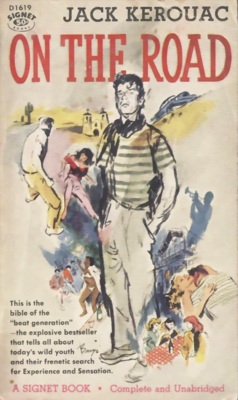
Showing posts with label On The Road. Show all posts

Friday, February 15, 2008

Links to Reviews of Kerouac's Works


In my never ending quest to spread the wonderfulness of the works of Jack Kerouac, I've discovered some online links from such sources as the NY Times , as well as ones like Empty Mirror . There also a source for sites on Kerouac as well. -Ed


(Below: Kerouac's originally suggested layout design for the cover of On The Road)

Monday, February 11, 2008

Report on Beats At Columbia University


(Left: Philosophy Hall at Columbia University.)

Last Friday (2/8/08) afternoon, I managed to attend the fourth annual celebration of Columbia University's Beats, which were a series of events held at the campus under the umbrella title On The Road Turns 50! As the proceedings began late in the afternoon (after 3:30pm), I wasn't able to stay for all of them. But I did manage to get in two of the events.


After 3:30pm, in room 301 of Philosophy Hall (pictured above), a round table discussion, On the Road: Then and Now began. Scheduled speakers included Professor Regina Weinreich from the School of Visual Arts (whose Kerouac's Spontaneous Poetics is carried by the library), NY Times reporter John Leland (author of the recent Why Kerouac Matters, which we also carry in the library), jazz musician David Amram, and former Kerouac girlfriend and a noted author in her own right Joyce Johnson (Minor Characters and Door Wide Open are her two memoirs about her experiences with Kerouac and the Beats). The moderator was Penny Vlagopoulos from Columbia (see her profile here ) who worked on & wrote an introduction for last fall's publication of On the Road: The Original Scroll .


David Amram


John Leland


Books by Joyce Johnson

As expected, the discussion turned on the subject of how big an impact On the Road had at both its time of publication in 1957 and the present day. John Leland noted that Road is really about the character of Sal Paradise (Kerouac) not Dean Moriarty (Neal Cassady) and how Sal, not Dean, changes by the book's end. Mr. Leland also noted that the Beats were the first generation of writers on television and the last generation not shaped by TV and/or popular culture. Both Mr. Leland and Ms. Johnson noted that by the time Road was published in 1957, Kerouac, who had finished the final draft six years before, felt it was an "old book" and that his voice was stronger in his later works (Doctor Sax; The Dharma Bums; Big Sur) , but that the publishers wanted another Road novel instead.


Regina Weinreich

Regina Weinreich noted that the book was basically "Huck Finn in a car", with the characters' reacting to events as they drove along the country and David Amram pointed out that Kerouac had a great ear for conversation which he was able to repeat in his books and that Kerouac always encourged other writers & artists as well.

Afterwards, I got to attend the exhibit The Author as Artist which showed drawings of the Beats as they saw themselves. Not bad.

Overall, a terrific program. Thanks to Wynnkie Delmhorst for telling me about this event. -Ed

Friday, January 11, 2008

Grace Metalious' Peyton Place: The Great Lost Beat Novel?!?


Back in October, when I attended the Jack Kerouac Conference at the University of Lowell in Massachusetts, I took note about how one of the featured speakers made this interesting observation:

UConn Professor Richard Pickering came on to deliver his paper “It’s Like Turning Over a Rock with Your Foot: On the Road and Peyton Place as Pandora’s Boxes”. Citing the popular culture of 1956-57, when Detroit had more cars being built, Elvis was on the radio, and television was showing Civil Rights protests to a wide audience, Professor Pickering argued that the success of Grace Metalious’ Peyton Place (which was considered quite shocking at the time due to its depiction of rape, infidelity and overall sexuality), released in hardcover in ’56, not only engendered a ready-made audience of teens as well as adults waiting to pick up the cheaper paperback edition published the following year, but also whetted their appetites for Kerouac’s On the Road (also released in 1957). Pickering also made a persuasive augment for the enduring merits of the Metalious novel, citing his assigning it to his students, who found they couldn’t put it down.


(Above, top: Peyton Place book cover. Below: Grace Metalious)

Of course Professor Pickering's (current day) students couldn't put the book down! After 52 years, Peyton Place still rocks the world with it's alternatively adult and near-sordid depiction of the dark secrets underneath a small (slightly fictional) New England town sometime in the 1930's, as seen through the eyes of central character, young teen ager Allison MacKenzie. There's alcoholism, incest, murder, teen age sex, illegitimate births and so much else going on that it's easy to forget Metalious has managed to craft a riveting narrative that holds the audience's attention, even when shifting from one group of characters (there's quite a large cast) and situations to another. (Said scene shifting, along with some purple prose, are probably the only real drawbacks of the novel.) And the language! Except for the likes of such then-popular authors Norman Mailer, James Jones and Mickey Spillane, no best selling author ever used such graphic and profane words in a popular novel that wasn't male-oriented. (I may be wrong, but, aside from various female pulp writers using male-sounding pseudonyms, Grace Metalious may be the first prominent female novelist to write such coarse-yet-realistically "rough" dialogue in her works. Can anybody out there confirm this?)


Metalious' then-bold and frank description of adult situations caused quite a bit of outrage in it's day. Most critics hated the book, yet the public made it an instant best seller. More importantly, when Kerouac's On The Road came out in hardcover the following year, it was joined by the first paperback printing of Peyton Place, which, thanks to it's lower price and smaller size (easier to hide it from one's parents or spouse)became even more accessible to readers eager to see what the fuss was about. Meanwhile, those that had already read the book moved on to the similarly mature-themed Road novel, itself already getting its' fair share of outrage.

(Below: Covers of Kerouac's and Metalious' follow up novels.)


But is Peyton Place really "Beat"? Well, just barely. Again citing the mature themes of the book mentioned earlier, the novel also shares, especially with the works of Kerouac and the poetry of Allen Ginsberg, a central character (Allison) who wants more out of life than what's being offered, while becoming aware of the dark underbelly of her surroundings. That's silmilar to the desires Road's protagonist Sal Paradise carries. Sal, like Allison, has to grow up and mature to survive, while still seeking some kind of internal satisfaction/justification for his existance.

Grace Metalious probably didn't see herself as a Beat writer. But her most popular novel (a sequel, Return to Peyton Place, came out in 1959, followed by one or two lesser books before her untimely death, from alcoholism at the age of 39, in 1964)certainly shares many Beat characteristics. (And yes, the manner of Metalious' death does prefigure and parallel that of Kerouac's, who died of similar circumstances five years later.)


The library only carries the first Peyton Place novel. I'll ask the video librarian about getting the 1957 movie version, currently available on DVD, for the catalog.


(Peyton Place and it's immediate sequel were made into very popular, if slightly sanitized, movies in 1957 and 1961, respectively. A quite popular television serial (which I barely remember), starring Mia Farrow as Allison, and featuring a then-unknown Ryan O'Neal, aired from 1964-69 on ABC. Some years back, Barbara Delinsky penned a sort-of sequel to Metalious' novel, Looking for Peyton Place in 2005. As for the tragic life and times of Grace Metalious, click here.)

-Ed

(Below: Photo of the 1960's Peyton Place television cast. Currently, there are no plans announced to release the series on DVD.)


(Clockwise from right: Ed Nelson, Christopher Connelly, Ryan O'Neal, Barbara Parkins, Mia Farrow and Tim O'Connor.)

Tuesday, November 6, 2007

Shameless Staffer Plug


Last March, I had invited Dr. Isaac Gewirtz, curator of the Berg Collection at the New York Public Library to be guest speaker at the second Beat Generation program held here, Focus on Jack Kerouac. Dr. Gewirtz was in the process of putting together an exhibition on the life & works of Kerouac to celebrate the 50th anniversary of the publication of On The Road. The exhibition would include various unpublished, never-before-seen writings (including journal entries, first drafts, essays, short stories and even a fantasy baseball roster) and artwork. Dr. Gewirtz was able to put together a power point presentation of the exhibition for our program last March, giving staff and the community a great "sneak peek" at what the New York Public Library would unveil, as well as giving a terrific overview of Kerouac's life and his progression as an author. (Basically, we "scooped" other libraries on news about the exhibition.)


Well, last week I received an invitation to attend the opening reception & viewing of the NY Public Library's new exhibition Beatific Soul: Jack Kerouac On The Road. The opening will be at NY Public this Thursday night (November 8) at 6:30 pm, with the exhibition officially open to the public November 9 to March 16, 2008. Information can be glommed at http://www.nypl.org/press/2007/Beatific_exhibition.cfm or at NYPL's home page (http://www.nypl.org/index.html). And Dr. Gewirtz has also finished a companion book to the exhibit, which should be out in January.


It goes without saying that without the support of staff & public alike, my Beat Discussion program would never have gotten this sort of acknowledgement. To be recognized in this way helps support & holds in high esteem the efforts of myself & my fellow programmers in fulfilling the requirements of our Library's Mission Statement, as well as expose audiences to literary artists & works they might otherwise not known of.


Thank you all for your support of this program. I promise to represent the best impression Greenwich Library can make at the reception. Provided I don't bump into any furniture...


-Ed